
and Your Army Goes Marching to Hell
The Opening Strike
Just over a week ago, on 28 February 2026, a surprise American-Israeli air offensive targeted key Iranian leadership and infrastructure. This ignited a new war between Israel, the United States, and the Iranian-led Axis of Resistance.
BREAKING🚨⏰: The United States, in conjunction with Israel, has begun targeted strikes in Iran's capital city, Tehran with the intent of assassinating senior figures of the regime. pic.twitter.com/RZQGZp0nMj
— Outpost Media (@OutpostMediaUK) February 28, 2026
What began as coordinated air and drone strikes has rapidly escalated into a regional conflict. Iranian missile strikes have hit Israel and US bases across the Gulf. Allied militias and proxy forces have launched attacks across multiple fronts.
This has already caused a massive amount of outcry, with much coming from the American Right. A number of prominent voices have begun publicly questioning the war. Tucker Carlson, a long-time Trump ally and isolationist voice, has described the conflict as "Israel’s war" rather than America’s. He has warned that it does not advance US security or prosperity.
Tucker Carlson says the decision for the U.S. to go to war with Iran was not made by the United States itself, but by Israel 🫣
— Charging… (@RedPillSayian) March 2, 2026
“President Kennedy said no….and that was the last time an American president said no to Israel.” pic.twitter.com/TNCsAT6lM2
Marjorie Taylor Greene has gone further. She has denounced the conflict as "AMERICA LAST" and accused Republicans of backing an "Israel first" policy.
Marjorie Taylor Greene says Make America Great Again "was supposed to be America First, not Israel First":
— The American Conservative (@amconmag) March 2, 2026
"72% of Americans can’t afford health insurance. 67% live paycheck to paycheck. 31% can’t afford their back taxes. 50% are in credit card debt." pic.twitter.com/jRUDrwbLQM
Conservative commentator Matt Walsh has questioned what benefit the war brings to American citizens. Figures such as Megyn Kelly and Steve Bannon have warned that prolonged conflict will fuel growing discontent among voters who supported Trump on promises of avoiding new wars.
Matt Walsh: "The idea that we're obligated to just assume it's a good move because Trump decided to do it is asinine—not to mention un-American…The most powerful voices in the conservative movement are calling for a long war in Iran, which is explicitly contrary to what most of… pic.twitter.com/ctDPs0YTZa
— Cesspool (@CesspoolOnline) March 2, 2026
This clear departure from Trump’s “America First” rhetoric isn’t likely to be forgotten by his base anytime soon. Even still, a wide array of damage to civilian targets (including a girls school in Iran where over 140 girls were killed by an Israeli strike) means this war will be marred with controversy for a long time.
What many initially dismissed as another contained tit-for-tat, echoing the futile Twelve Day War of 2025 - a brief but intense missile exchange between Israel and Iran - is quickly ballooning into a catastrophe for the Zionists.
Initial US-Israeli strikes, including precision drone attacks that assassinated Iran's Supreme Leader, Ayatollah Ali Khamenei, and the decimation of IRGC command centres in Isfahan and Qom, were arguably successful.
However, Iran's retaliation has obliterated critical US-Israeli assets across the Middle East. This has crippled their vaunted missile defence shields and proved the hollowness of Western technological superiority.
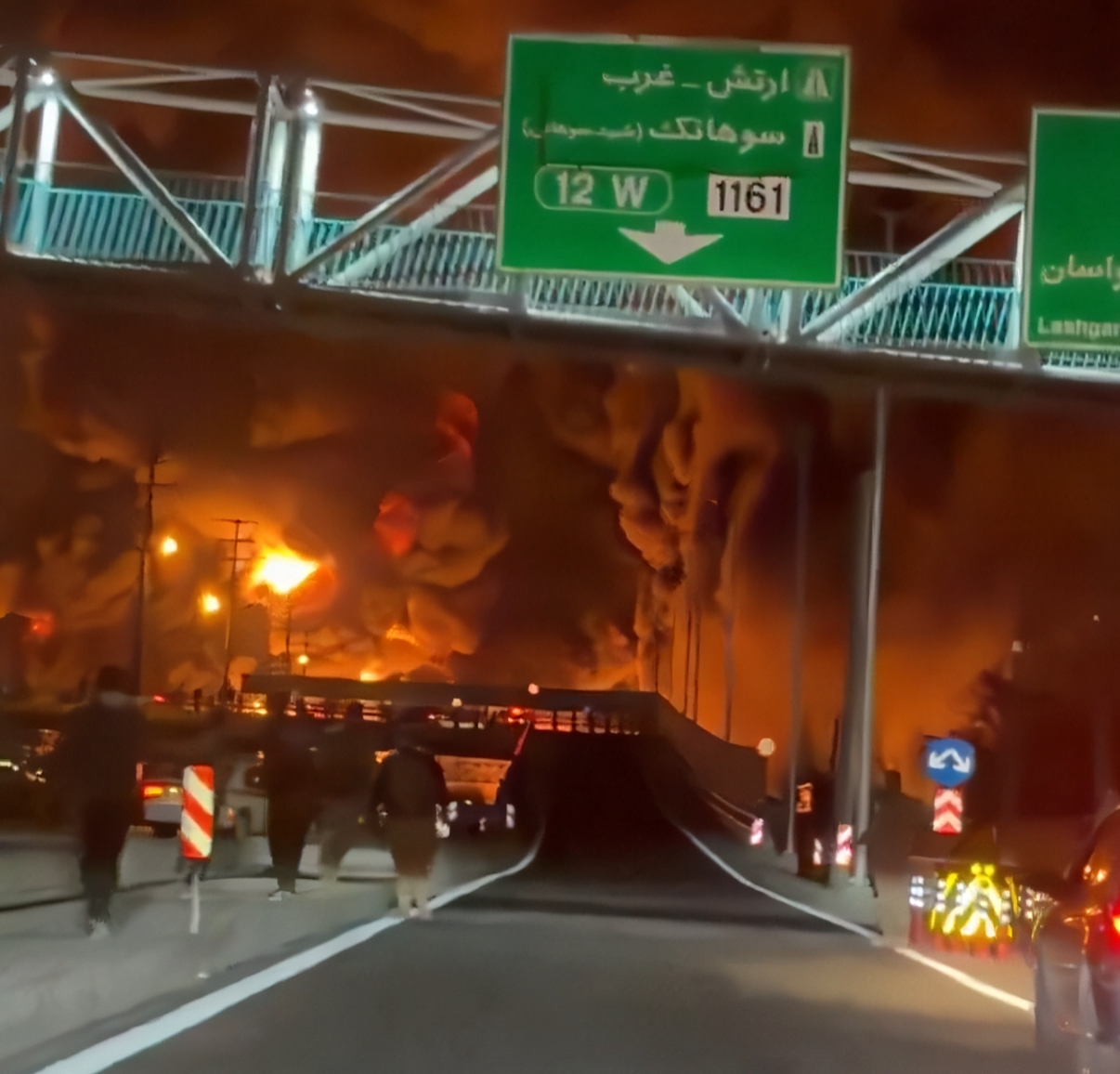
Already, just a few days in, the attritional effects of the war are staggering. As of 8 March 2026, the conflict has entered its ninth day. Ongoing strikes include US-Israeli aerial bombardment of oil depots in Tehran, causing widespread fires and explosions.
🚨🇮🇷NEW: Videos coming out of Tehran a couple hours ago showing borderline apocalyptic scenes.
— Outpost Media (@OutpostMediaUK) March 8, 2026
Oil depots were hit by intense US- Israeli aerial bombardment, with locals reporting multiple explosions. pic.twitter.com/ANFuF3MNdO
In retaliation, Iranian drones have hit desalination plants in Bahrain, causing material damage and injuring several people.
Radar and Sensor Losses
In terms of radar and sensor technology alone, the United States has already lost systems that form the backbone of the regional missile detection and interception network used by American and Israeli forces:
- At least 1 AN/TPY-2 (THAAD) radar confirmed, with reports of more
- 1x AN/FPS-132 Block 5 UEWR
- 1x AN/MPQ-65 Radar Set (PAC-3)
- 1x ECS (PAC-3)
- 2x AN/GSC-52B
- 7x Additional unidentified radars and other sensors
These amount to an estimated $4 billion worth of materiel losses. This is without getting into the cost of interception missiles that had already been heavily depleted by last year’s exchanges. Estimates for the war’s cost frequently exceed $1 billion a day.
In the case of the AN/FPS-132 lost in Qatar - another is suspected to be destroyed but no confirmation yet - this costs over $1.1 billion alone. It is expected to take between 5-8 years for a replacement to be built. Even less complex radar systems require at least twelve months to manufacture and deploy. This means the gap in defensive capabilities caused by the destruction of these radars won’t be filled easily.
NEW🚨🇯🇴🇺🇸🇮🇱🇮🇷: Images have surfaced of a TPY-2 radar, used in the THAAD air defence system, after it was destroyed by Iranian strikes in Muffawaq Air Base, Jordan. pic.twitter.com/9PxPCikUrU
— Outpost Media (@OutpostMediaUK) March 7, 2026
Iranian strikes are not only making the continuation of the war economically unviable. They are doing great harm to American-Israeli strategic capabilities in the region. Early warning capabilities over Israel have seen reported reductions in some areas.
A History of Intervention
US-Israeli animosity toward Iran did not erupt spontaneously. It is the legacy of decades of imperial meddling and sabotage.
In 1953, the CIA orchestrated Operation Ajax in collusion with British intelligence. The operation toppled democratically elected Prime Minister Mohammad Mossadegh after he moved to nationalise Iran's oil industry. This had long been dominated by the British-owned Anglo-Iranian Oil Company.
The coup restored the authority of Shah Mohammad Reza Pahlavi. He increasingly ruled Iran as a pro-Western strongman backed by American arms, intelligence and financial support.
For the next twenty-five years, the Shah's regime functioned as a cornerstone of Western influence in the Middle East. It acted as Washington's so-called "policeman of the Gulf".
This stability was maintained through an increasingly authoritarian security apparatus. The Shah's secret police, SAVAK, became notorious for its surveillance, imprisonment and torture of political opponents. This fuelled resentment across Iranian society while Western governments continued to provide diplomatic and military backing.
By the late 1970s this resentment had reached breaking point. The Shah’s increasingly authoritarian methods of maintaining control sparked mass protests across the country, which began in 1979.
The Carter administration attempted to dial back support for the regime as the crisis escalated. But by the time Washington attempted to adjust course the situation had already slipped beyond its control.
The Islamic Revolution shattered the alliance between Iran and the United States. What had once been Washington's most reliable regional partner was replaced with an ideologically radical state openly hostile to Western influence. It was determined to expel it from the Middle East.
The loss of Iran as America's regional anchor represented one of the greatest geopolitical setbacks for Washington during the Cold War.
Ever since, the US and Israel have waged an all-encompassing campaign against Iran. They are determined to undermine its economic, political and military sovereignty.
During the 1980–1988 Iran–Iraq War, the United States tilted decisively toward Saddam Hussein. Washington provided Iraq with intelligence support, satellite imagery and relaxed export controls. These allowed Iraq to obtain materials used in chemical weapons production.
These measures enabled Iraqi forces to carry out devastating attacks against Iranian troops. Western governments largely ignored Iraqi war crimes.
In 1988, the USS Vincennes shot down Iran Air Flight 655 over the Persian Gulf. This killed 290 civilians in an act of catastrophic recklessness. The United States later described the incident as a mistake. But the event permanently hardened Iranian hostility toward Washington. It became one of the defining symbols of American impunity in the region.
Iran's Doctrine of Resistance
Since then, Iran has shifted its economy, military and political institutions to prepare for what it sees as the inevitable attempt at regime change in the country.
The Iranian state has spent decades reorganising itself around the assumption that a major confrontation with the United States and Israel is not a matter of if, but when.
Iran’s resilience stems in part from geography. The country is vast, mountainous and difficult to invade. Its terrain heavily favours defensive warfare.
Any conventional invasion would require enormous manpower and logistics. This would force an attacker to fight through multiple natural barriers while operating deep inside hostile territory.
With a population of more than eighty million people and a military culture shaped by the brutal experience of the Iran–Iraq War, Iran possesses both the manpower and the national memory of total war required to sustain prolonged resistance.
Rather than attempting to compete directly with Western air and naval power, Iran has adopted a doctrine that can most accurately be compared to guerilla warfare conducted at the level of the state.
Where sanctions have made competition in conventional air and naval capacity nearly impossible, Iran has instead developed asymmetric strategies designed to neutralise Western technological advantages.
These strategies include the funding and coordination of neighbouring militant groups to act as both a buffer and an extension of the front line.
They also include the widespread use of missiles and drones capable of inflicting significant damage without requiring air superiority.
A highly decentralised command structure is resistant to the leadership decapitation tactics often employed by Western militaries.
Command structures are intentionally redundant. Authority is dispersed across multiple layers of leadership. Operational autonomy is often delegated to local commanders.
The result is a military apparatus capable of absorbing the loss of senior figures while continuing to function.
The Axis of Resistance
At the centre of this system sits what has become known as the Axis of Resistance. This network includes Hezbollah in Lebanon, Popular Mobilisation Forces militias in Iraq, HAMAS and Palestinian Islamic Jihad in Palestine, the now collapsed government of Bashar al-Assad in Syria, and Yemen's Ansar Allah movement, more commonly known as the Houthis.
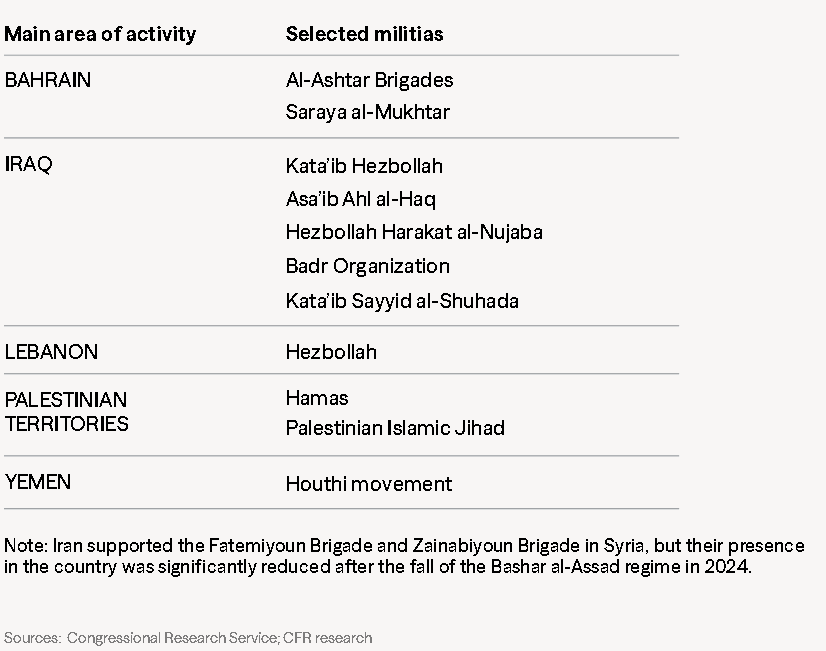
While these groups differ in ideology and structure, they share a common strategic alignment: resisting American military presence and Israeli regional dominance.
Together they form a decentralised security architecture that allows Iran to project influence across the Middle East while avoiding direct conventional confrontation.
Each component contributes in different ways. Hezbollah possesses an enormous rocket and missile arsenal capable of threatening northern Israel.
Iraqi militias create constant pressure on American bases across Iraq and Syria. Palestinian factions maintain a permanent frontline against Israel itself.
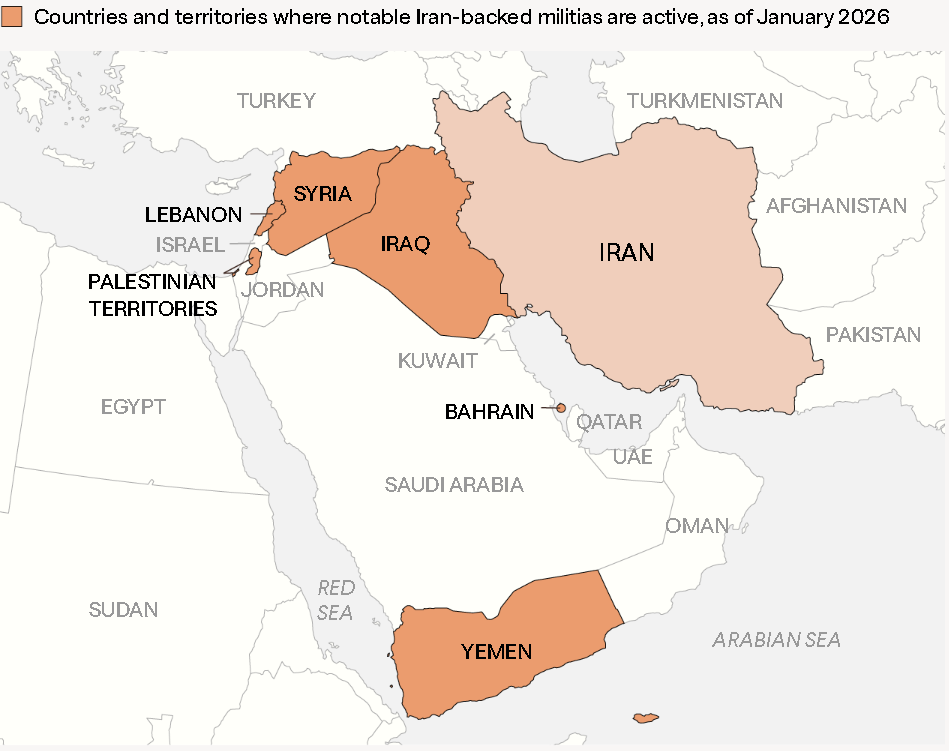
Further south, Yemen's Ansar Allah movement has demonstrated the ability to threaten Red Sea shipping lanes and strike deep into the Arabian Peninsula.
Even after the collapse of the Syrian government, pro-Iranian networks in the country continue to provide logistical depth connecting Iran to Lebanon.
These groups therefore serve two complementary functions. They act as forward instruments capable of striking Iran’s enemies by land. They simultaneously force Israel and the United States to disperse their military resources across multiple theatres.
Proxy Impacts and Timelines
The involvement of proxies has amplified the conflict's reach. It has created a multifront war that stretches resources thin.
For instance, on 6 March 2026, Yemen's Houthis sank a US-linked tanker in the Red Sea. This disrupted shipping lanes and escalated maritime tensions.
Iraqi militias have rocketed Al-Asad Airbase in Iraq repeatedly since the war began. This includes major barrages on 3 March and 5 March.
Hezbollah has pummeled Haifa with Katyusha rockets from Lebanon. Strikes intensified on 4 March, causing civilian evacuations. They have also successfully repelled Israeli actions in the region, capturing IDF paratroopers following the downing of a helicopter in Eastern Lebanon.
NEW🚨🇮🇱🇱🇧: A video has surfaced which appears to depict the capture of IDF paratroopers by Hezbollah in Lebanon. pic.twitter.com/85EGMeMmYw
— Outpost Media (@OutpostMediaUK) March 7, 2026
These proxy actions align with Iran's asymmetric strategy. They distract and drain US-Israeli forces while allowing Iran to build up its capabilities without facing the full force of their militaries.
Why Israel Struck Now
This most recent war was ultimately forced by an increasingly unfavourable situation for Israeli strategic goals in the region.
For decades, Israel has pursued a strategy of neutralising organised opposition to its occupation and regional expansion by normalising relations with moderate Arab states, and destabilising anti-Zionist neighbours. The Abraham Accords represented the substantial success this policy has had in recent years.
Iran has long represented the most serious obstacle to this strategy. By continuing to arm and support movements resisting Israeli power, Tehran prevented Israel from fully consolidating its regional position.
At the same time, Iran’s missile arsenal has grown dramatically in both scale and sophistication. Israeli figures have also rolled out the typical “weapons of mass destruction” accusations, despite the existing fatwa in place against nuclear weapons.
Domestic political pressure within Israel has intensified following years of conflict in Gaza and Lebanon. Large sections of the Israeli political establishment argue that the Iranian challenge must be confronted directly.
At the same time global public opinion has shifted sharply against Israel. This narrows the diplomatic window for major military operations. Major European allies had already begun to dial back support for Israeli actions, and the US faces an impending midterm election.
The result was a rapidly closing strategic window. If Israel was going to attempt a decisive strike against Iran, it would have to happen soon.
The Failure of Decapitation
US-Israeli planners, drunk on their previous “successes” in the region, bet on decapitation strikes to shatter Iran's will.
The assumption behind these operations is simple: eliminate senior leadership figures, create confusion within the command structure, and allow the enemy state or movement to collapse into paralysis.
This logic shaped the invasion of Iraq in 2003 and the NATO intervention in Libya in 2011. Even smaller operations relied on the same assumption, including the 2020 drone strike that killed Iranian General Qasem Soleimani.
Yet these interventions repeatedly produced the opposite effect.
Instead of collapsing, Iran absorbed the loss of leadership and continued operations through redundant command structures.
Within hours of the assassination strikes, Iranian forces launched retaliatory missile attacks across the region.
Industrial Limits of Western Warfare
Barred from modern aircraft by sanctions, Iran pivoted to missiles. It has built the largest missile arsenal in the Middle East.
Iranian drones may cost tens of thousands of dollars, while intercepting them requires missiles costing millions.
This creates a devastating economic imbalance.
Iranian doctrine relies on saturation attacks. It launches large waves of missiles and drones simultaneously to overwhelm defensive systems.
🚨🇮🇱NEW: Ballistic missile and debris impacts are being reported across central Israel launched from Iran. pic.twitter.com/xn5HqZObnX
— Outpost Media (@OutpostMediaUK) March 8, 2026
Systems such as Patriot and THAAD struggle under these conditions, particularly when interceptor stockpiles begin to run low.
Western deindustrialisation compounds the problem. For decades Western economies prioritised finance and global supply chains over domestic industrial capacity.
The result is a defence sector capable of producing extremely sophisticated weapons in small numbers. But it is poorly suited for prolonged industrial warfare.
Economic Fallout
The war has triggered significant economic fallout. Oil prices have spiked by 7-12 per cent to around $70-80 per barrel since the conflict began. Disruptions in the Strait of Hormuz have halted key shipments, pushing up global energy costs.
If prolonged, prices could reach $100-200 per barrel. This would boost inflation by 0.5-1 percentage point and slow GDP growth by 0.25-0.4 percentage points in major economies.
Emerging markets are particularly vulnerable. Sustained high prices risk tipping Europe toward recession and complicating US monetary policy.
🚨🇰🇼NEW: A low-resolution video circulating today, Thursday, March 5, 2026, purports to show several ballistic missiles striking an oil refinery in Kuwait. pic.twitter.com/PAlPZvFfgl
— Outpost Media (@OutpostMediaUK) March 5, 2026
The War That May Change the World
This war, despite its location, is another front in the struggle between globalism, or American-Israeli imperialism if you prefer, and those who seek to retain control of their own destiny in their own lands.
For more than three decades after the collapse of the Soviet Union, the United States exercised near-uncontested global power. Governments could be bombed, sanctioned or invaded with little fear of meaningful retaliation.
But this dominance has been eroding for years.
The invasion of Iraq destabilised the region while strengthening Iran. Libya collapsed into chaos after NATO intervention. Afghanistan ended with the Taliban returning to power after twenty years of war.
History is likely to repeat again, especially given the stark difference in what either side has to achieve to ‘win’. Iran’s strategy is not decisive victory, but attrition. So long as the regime lives to fight another day, and the balance sheet is in their favour, they can claim victory.
Meanwhile, American-Israeli war aims mean that anything short of destroying Iran’s missile infrastructure, eliminating its nuclear capability, and bringing about the end of the Islamic Republic would constitute failure.
Each destroyed radar system, each depleted interceptor stockpile, and each disrupted shipping lane chips away at the economic foundations of the military order the United States has maintained since the Gulf War, and erodes the confidence of the allies that America has made along the way.
Just as Vietnam exposed the limits of American intervention and Afghanistan revealed the futility of occupying hostile societies indefinitely, this war may expose the limits of US-Israeli dominance in the Middle East.
The Cold War was won because the US could outspend and outgun the USSR. However, when the situation goes hot, and you have to use the most expensive weapons man has ever made, the flaws of the US war machine become clear.
History never ended. It was just waiting for us to be brave enough to get it moving again.