
Islamist Mob Rule In The West Midlands?
by Dan Haley | @cymroofbarri89 on X
West Midlands Police and Birmingham City Council have come under intense scrutiny from Parliament’s Home Affairs Committee over their controversial ban on Maccabi Tel Aviv supporters late last year.
In the run-up to the November fixture, the narrative advanced by the police, the council and prominent Muslim MPs, particularly Ayoub Khan, Iqbal Mohammed and Adnan Hussein, was that the ban was necessary due to “safety concerns” for local residents.
Birmingham’s Safety Advisory Group (SAG) classified the match as high risk, citing previous incidents of unrest and unruly behaviour by Maccabi supporters at other fixtures. The justification relied heavily on a 2024 match in Amsterdam, where it was claimed that up to 600 Maccabi fans had targeted Muslim communities the night before the game, including allegations of “serious assaults”, such as members of the public being thrown into a river.
SAG also claimed that as many as 5,000 police officers had been deployed to contain the disorder, despite having previously cited a much lower figure. These claims were later directly contradicted by Dutch authorities. A Dutch police representative stated they were unaware of any such incidents, a position later confirmed by the police oversight body. In a letter obtained by BBC News, Dutch Inspector Liesbeth Hujizer said, “we do not see any new facts or circumstances that would warrant revising these findings”.
Further doubts emerged after The Sunday Times reported leaked information from a SAG meeting which revealed that a ban remained the preferred option despite an acknowledged “absence of intelligence”. Those present at the meeting, including councillors, officials from multiple authorities and Aston Villa Football Club, were instructed that the discussion was confidential and “must not be shared”.
Despite the conflicting evidence from Dutch police, West Midlands Police persisted with their justification, citing “significant intelligence” and a “potential for disorder” from Maccabi supporters, again relying on the same disputed fixtures. Chief Constable Craig Guildford continued to stand by the credibility of this intelligence.
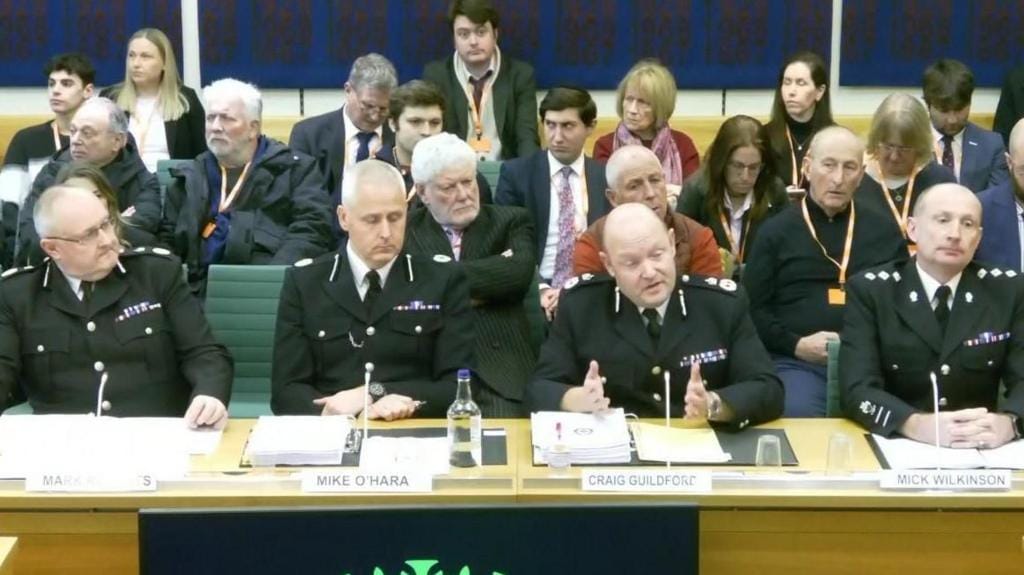
These claims were tested during a Home Affairs Committee session that has since circulated widely online. Chief Constable Guildford, Assistant Chief Constable Mike O’Hara and senior colleagues were questioned by MPs, including Labour Friends of Israel Vice Chairs Jo White and Peter Prinsley, the Chair of the All-Party Parliamentary Group Against Antisemitism, Joani Reid, and Home Affairs Committee Chair Karen Bradley.
During the hearing, O’Hara insisted there was no conspiracy and that the decision had been “based on safety”. The session took a dramatic turn when Peter Prinsley cited a report in The Times stating that police had intelligence as early as 5 September that vigilante groups within the West Midlands community itself were planning to take action against the visiting supporters.
The silence that followed was telling. Chief Constable Guildford visibly hesitated before responding that the panel had not asked for specific details. Committee members were clearly stunned, with the Chair pointing out that such information should have been disclosed proactively rather than extracted under questioning.
Matters deteriorated further when MPs referred to statements from Dutch authorities which directly contradicted West Midlands Police’s account. Dutch evidence stated that threats originated from social media posts calling for aggression against Israelis. Pro-Palestine slogans were spray-painted around the arena, slide projections with anti-Israel messaging were directed at the venue, and approximately 50 Maccabi supporters were specifically targeted. None of this featured in the police correspondence used to justify the ban.
Calls for the Chief Constable’s resignation have since intensified, but the issue goes far deeper. The problem appears systemic. The evidence strongly suggests that the threat came not from visiting football supporters, but from elements within the West Midlands community itself, including individuals “wanting to arm themselves”. This was never about football. It was another instance of foreign ethnic and religious conflicts playing out on British streets, with ordinary citizens caught in the middle.
The parallels with previous failures are difficult to ignore. The Israel–Palestine conflict has already had lethal consequences in this country, most notably the Manchester Arena terrorist attack. Yet once again, police charged with public protection appeared to capitulate in the face of intimidation. Birmingham’s Muslim population now approaches 30 per cent, and Chief Constable Guildford has further damaged confidence by publicly courting community approval, including appearing in a video greeting audiences in Arabic. The situation was compounded by revelations in The Sunday Times that Kamran Hussain, leader of Green Hill Mosque, sat on the interview panel that appointed Guildford as Chief Constable.
This is not an isolated episode in the history of West Midlands Police. In 2010, the force was already aware of organised Pakistani grooming gangs operating openly near schools. An internal report warned that “the predominant offender profile of Pakistani males combined with the predominant victim profile of white females has the potential to cause significant community tensions”. Rather than confront the issue, the report was suppressed and only released nearly five years later following a Freedom of Information request. During that time, vulnerable English girls were left exposed, seemingly to avoid offending a particular community.
Similar dynamics were evident in the same year when a UKIP protest in Tower Hamlets was rerouted due to fears of disorder from the majority Bangladeshi community. Scenes of organised, black-clad men openly asserting territorial control were widely observed.
Birmingham itself has undergone profound demographic change. Once the “workshop of the world”, it became a minority White British city for the first time in its history according to the 2021 Census. White British residents now account for 48.6 per cent of the population, while 51.4 per cent identify as Black, Asian or from other minority ethnic backgrounds, including sizeable Pakistani, Black, Indian and Bangladeshi communities.
What this case exposes is a growing pattern in which entire immigrant enclaves appear able to exert pressure on public authorities through intimidation and the threat of unrest. This culture of appeasement emboldens such groups, whose political influence continues to expand, even within Parliament itself. If this is the reality now, against the backdrop of a shrinking native population and a growing immigrant one, with leaders who too often pander at the expense of public safety, including the safety of children, the question is unavoidable. What will this country look like if this trajectory continues unchallenged?