
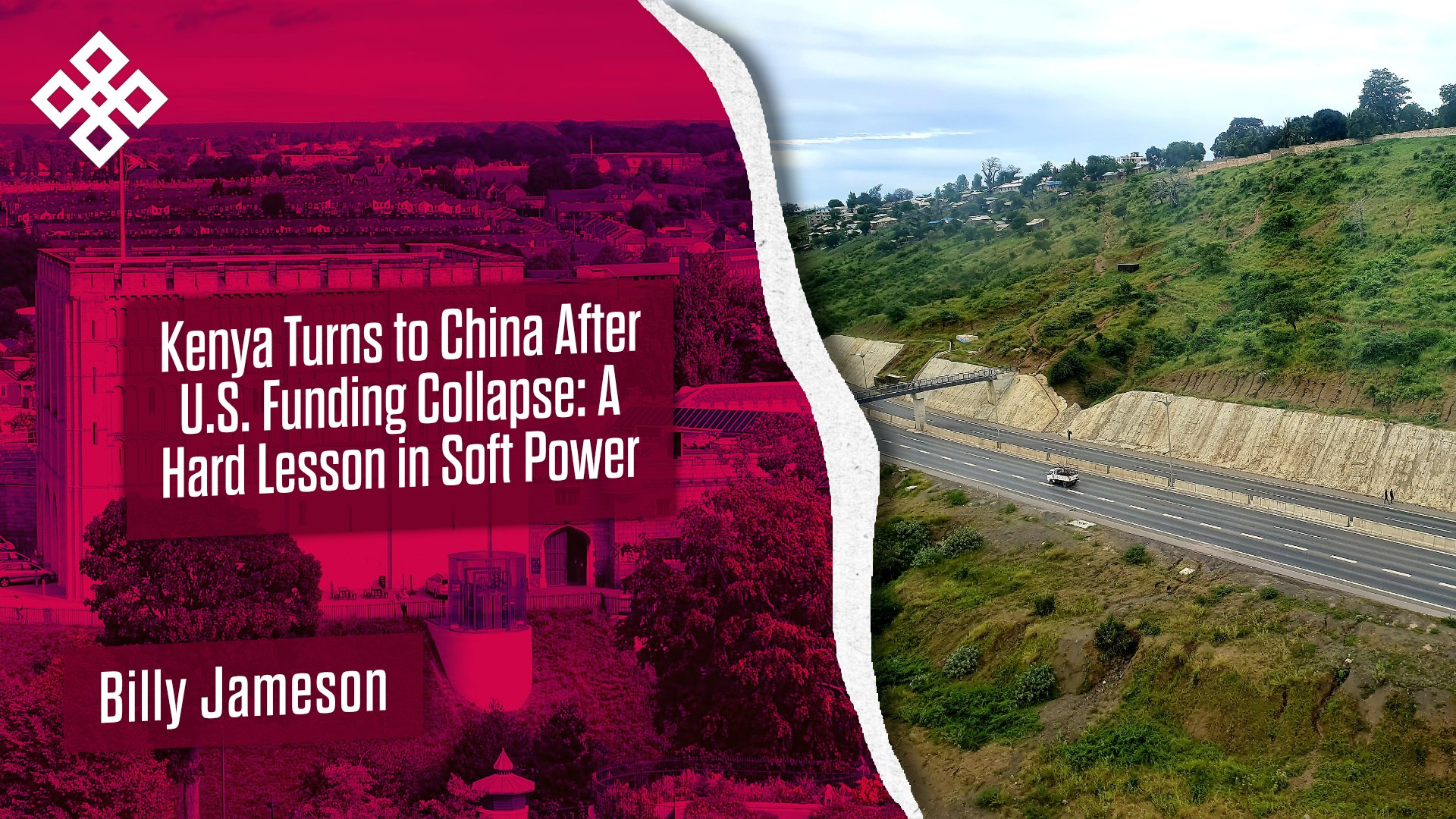
Kenya Turns to China After U.S. Funding Collapse: A Hard Lesson in Soft Power
Billy Jameson |
@BillyJamesonOM
Kenya has approved a $1.5 billion highway expansion to be undertaken by two Chinese state-owned firms, after a U.S.-supported alternative collapsed during a foreign-aid review earlier this year.
The deal, which covers the expansion of more than 230km of road between Mombasa and Nairobi, will be financed through a public-private partnership, granting Chinese contractors a 28-year toll concession once construction is complete in 2027.
The project marks China’s re-entry into East African infrastructure, following several years of reduced lending linked to African debt concerns. It also reflects Kenya’s shift in strategic partners.
A planned U.S.-funded Bus Rapid Transit scheme, backed by the Millennium Challenge Corporation (MCC), fell apart earlier this year when Washington withdrew support.
Beijing’s offer, by contrast, was immediate, comprehensive, and tied to Chinese construction firms that Kenya already knows can deliver on time.
For Kenya, the choice was straightforward: the road is economically essential. It links the port of Mombasa with the capital and with landlocked states to the west. Its expansion has been delayed for years. Where the US failed to deliver on even the most minor of projects, China has come to Kenya bearing vital infrastructure.
It speaks to a widening gap in how great powers convert money, infrastructure, and strategic attention into soft power: a gap created and made increasingly worse by incompetent American foreign policy.
The U.S. Problem: Infrastructure Isn’t in Its DNA Anymore
The American strategic outlook since the Cold War has been built on two pillars: security guarantees and capital flows. Countries in Africa, Asia, and Latin America know the U.S. can provide dollars, banks, military advisors, and governance workshops.
They also know the U.S. cannot, or will not, build a road.
Washington’s development institutions are highly risk-averse. Projects often die in bureaucratic review. ESG impact checks stretch on for years.
The MCC, USAID, and World Bank are politically constrained and culturally inclined toward adherence to process rather than physical construction. Even when they attempt infrastructure, the funding is modest and the timelines glacial.
China’s model is the opposite: fast, physical, and visible. Roads, dams, ports, and railways produce an immediate political return for local governments, and for Beijing.
The result is predictable. Chinese-built infrastructure has become the backbone of political relationships in Africa. Even nations and commentators sceptical of Beijing’s influence recognise that the Chinese state can actually get things built.
America, by comparison, increasingly looks like a social justice NGO with aircraft carriers.
Why China’s Model Generates Lasting Soft Power
China’s “Belt and Road” strategy works not because it traps countries in debt (though the debt is very real), but because infrastructure is the most durable form of diplomacy. A training programme ends. A workshop is forgotten. A policy loan is politically invisible.
But a road is a road.
A port boosts exports. A rail line creates new cities. A power plant rewires an entire country’s economic geography. These are structural forms of influence. China’s contractors become embedded in local politics. Chinese engineers live in the host country for years. Chinese lenders renegotiate terms face-to-face.
Over time, diplomacy becomes dependency. Kenyan land, but Chinese roads built by Chinese men with Chinese machines. If Kenya wants to keep running, China will be the one oiling the cogs.
The Chinese have simply revived an older truth Western powers once understood: infrastructure is statecraft.
Where Britain Fits In and Why We Should Pay Attention
Britain’s development budget, still among the largest in the world despite political controversy, mostly funds humanitarian programmes, governance reforms, NGO partnerships, and multilateral contributions.
These produce moral satisfaction but almost no long-term strategic benefit. If foreign aid is to exist at all, then it must be distributed in a way that is advantageous first and foremost to Britons.
A future nationalist government, seeking to reorient British aid toward national interest, has an opportunity the U.S. has largely abandoned: to use infrastructure as a tool of soft power, economic leverage, and resource security.
This does not require copying China’s model wholesale. It requires rediscovering principles Britain once excelled at:
-long-horizon foreign planning,
-engineering capability,
-and leveraging infrastructure for influence.
Where we currently fund Ethiopian Spice Girls and Javascript for Congolese orphans, we could instead learn a valuable lesson in diplomacy and take the proper steps to secure Britain’s future.
I have written previously about the need for the reindustrialisation of this country, but what I have not necessarily touched on is the vital need for an active foreign policy if this is to be achieved. The day of national autarky is over, reindustrialisation requires reassertion.
Conclusion
Kenya’s highway decision isn’t simply a story about Chinese contractors outcompeting American ones. It is a sign of a wider strategic realignment. Countries are choosing partners who build, not partners who preach.
To leaders outside the West, the difference is clear:
The U.S offers conditions; China offers concrete.
The U.S. offers political workshops; China offers bridges and power stations.
The U.S. offers process; China offers delivery.
If Britain wants to matter in the 21st century beyond its shrinking diplomatic footprint, it must stop treating aid as charity and start treating it as geopolitics.
A nationalist government with a clear-eyed view of national interest could turn the development budget from an expensive moral gesture into a tool of durable influence.
The nations that build the world will shape it. Britain can be one of them again.