
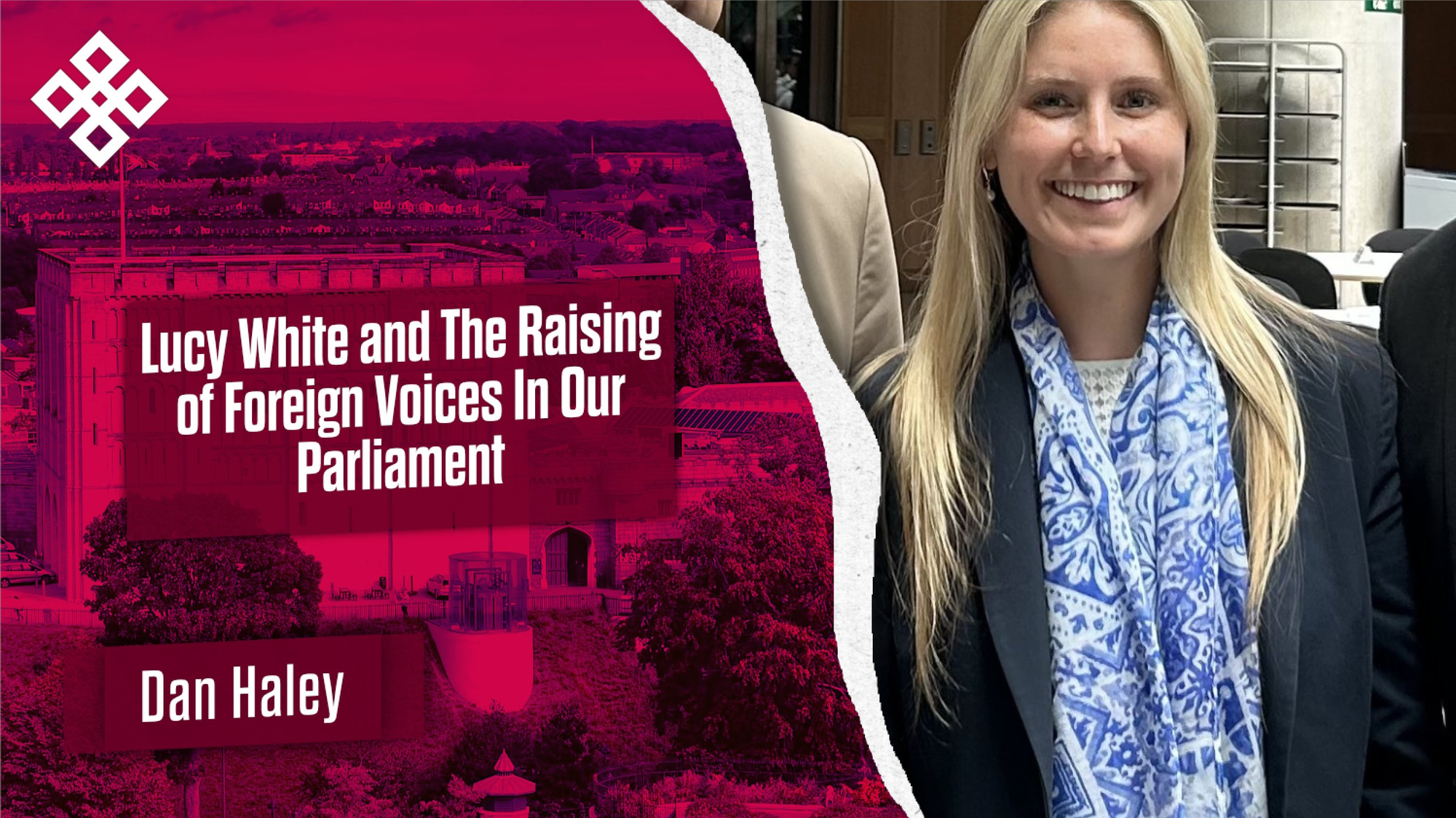
Lucy White and The Raising of Foreign Voices In Our Parliament
Lucy White recently ignited widespread controversy with remarks made online. In a since-viral post which garnered 15.3K likes and over 17,000 reposts, the GB News and TalkTV contributor criticized Senior Deputy Speaker Nusrat Ghani while she presided over the Budget statement. Noting that Ghani was born in Kashmir, Pakistan, White asserted that “there should not be a single person born in Pakistan in the UK House of Commons.”
The backlash was swift. TalkTV stated it has “no plans” to invite her back, and Conservative councillor Liam Walker branded her a “racist,” adding that “no broadcaster should put this racist on TV to spread her despicable hatred.” GB News also faces growing pressure to bar her from their platform, though the channel clarified that her comments “do not reflect the views or values of the channel.”
According to The Guardian, a spokesperson for Tell Mama, an independent group focused on tackling anti-Muslim hatred, said that such views “essentially marginalise and take out of our political life anyone who has an international heritage. This is distinctly discriminatory and verges on racially segregated discourse, which is simply a red line.”
White has defended her stance against critics from across the political spectrum. She responded, “It’s incredible how stating something so obvious, that English people should rule England, not foreigners, has sparked such a huge debate,” adding that “in pretty much any other country in the world, natives rule their own land. This is not controversial in the slightest.”
Indeed, in Nusrat Ghani’s native Pakistan, the Cabinet is 100% ethnically Pakistani, and the Constitution explicitly bars dual nationals from contesting elections. This standard is not unique to Pakistan, it is the global norm. A brief survey of governments from China, Japan, and Thailand to France, Spain, and Germany reveals leadership that is overwhelmingly native in both name and appearance.
By contrast, the UK now has 90 ethnic minority MPs: a record 14% of the House.
Twenty-six are of Indian origin and 15 of Pakistani descent, despite both India and Pakistan maintaining homogenous national leadership. It is natural for any native population to take notice when clearly foreign ethnic groups increasingly assume positions of governmental power.
While citizenship is the formal requirement for holding office in the UK and elsewhere, nearly every nation outside the Western sphere maintains a native-led government. India and Pakistan, the two largest non-native ethnic groups in the UK, account for approximately 2 million and 1.6 million people respectively according to the 2021 census, likely an undercount today. Their rising influence is reflected in figures like the UK’s current Home Secretary, who is of Pakistani heritage.
Lucy White’s comments, however contentious, did not emerge in isolation. They voice a growing sentiment regarding the nation’s stark demographic shift. The native White British population currently stands at just 74.4%, a figure that includes individuals of mixed and other ethnic backgrounds, suggesting the actual number may be even lower.
Wanting one’s own people to represent the nation is not extreme; it is the historical and global standard. Yet, after decades of mass immigration and enforced political correctness, many have felt unable to voice these concerns until now.