

The Great Replacement Fact: Now They’re Just Telling Us
For decades, ever since Renaud Camus coined the term in 2011, "The Great Replacement" has been dismissed by the establishment and Western elites across the political spectrum. From politicians to journalists, academics, and commentators, it was almost universally labelled a “far-right, white nationalist conspiracy theory.”
This so-called theory claims there is an orchestrated effort to replace native European populations with immigrants, particularly from non-EU countries. If that description no longer strikes you as far-fetched, you're not alone. Not only are some figures now openly acknowledging elements of it (often for political advantage), but census data and demographic trends provide concrete evidence supporting the observation of rapid population change through immigration.
They’re Not Even Trying To Hide It Anymore
Recent viral clips from Spain, France, and Davos have highlighted candid statements on this topic.
In Spain, Irene Montero, a former Minister of Equality, MEP, and member of the left-wing Podemos party, spoke at a rally with evident enthusiasm. She expressed support for policies to regularize undocumented migrants, grant them citizenship or voting rights, and ultimately replace "fascists," "racists," and "scroungers" with "migrants" and "hard-working people."
She stated: “Of course I hope for replacement theory. Hopefully we can sweep out right-wingers and racists of this country with migrant people, with hard-working people. Of course I want there to be a replacement, a replacement of right-wingers, replacement of racists, replacement of scroungers.”
Her comments tied into efforts to fast-track regularization for political gain, aiming to shift the electorate. This comes amid pushback from the right-wing populist party Vox, which has seen strong polling gains. In recent regional elections (such as in Aragon, where Vox doubled its seats), Vox has opposed initiatives like the 2024 plan to legalize around 500,000 undocumented migrants (the only major party to do so consistently).
In France, Jean-Luc Mélenchon, leader of La France Insoumise, has referred to building a “New France” and, in some contexts, invoked ideas aligned with demographic shifts. France has one of Europe's highest foreign-born populations, with estimates around 9.3 million in recent data (about 13-14% of the total population).
Immigrants from Algeria and Morocco form significant portions, and African nations accounted for roughly 45% of new arrivals in 2023. Paris has a high concentration of immigrants, with issues including elevated terror alerts (risk of ISIS-affiliated attacks), gang violence in certain neighbourhoods (often linked to African and Arab communities), and incidents like migrants squatting in a Parisian theatre in 2025.
Yet signs of resistance persist. In January, Paris saw its 22nd annual torchlight procession honouring Sainte-Geneviève, the city's patron saint and historical protector. Organized by the identitarian group Paris Fierté, around a thousand participants marched from Pont de la Tournelle to the city center.
Attendees included Remigration Now advocate Steve Laws, activist Callum Barker, and journalist Madeline Clarke, who documented the event amid some opposition. It represented a display of cultural pride and pushback against prevailing trends.
The “New” Europeans
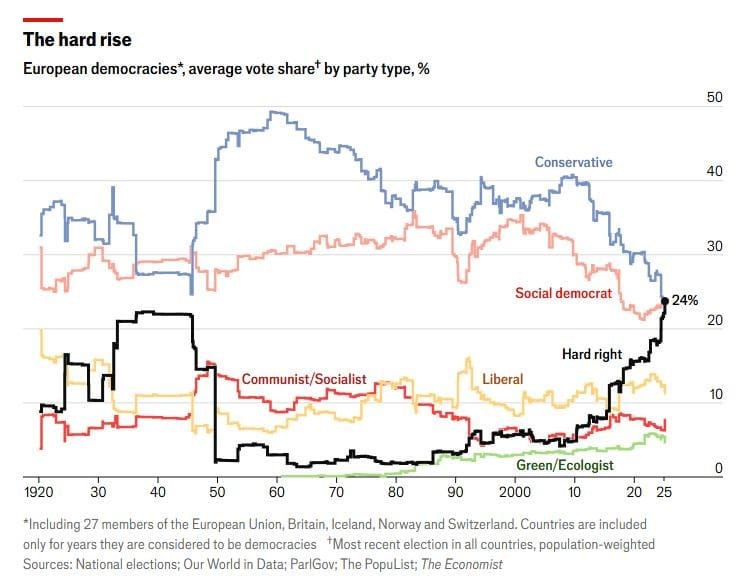
At the World Economic Forum in Davos in January, Rabbi Pinchas Goldschmidt, president of the Conference of European Rabbis, addressed the rise of the far right, attributing it partly to “insecurity felt by the so-called old Europeans regarding the new immigrants who came from the Middle East.” While acknowledging underlying anxieties about immigration, the framing of “Old Europeans” versus “New Europeans” implies a seamless transition that critics see as dismissive of native continuity and identity (native populations with deep historical roots in these lands).
Proposals for a pan-European, post-national identity (rooted in civic values, democratic principles, and cultural diversity) have been promoted, often at the expense of ethnic national identities. The EU's origins post-WWII emphasized overcoming narrow nationalism, including its ethnic dimensions. Recent developments, like the EU-India Free Trade Agreement, include provisions for faster, legal migration routes, suggesting continued large-scale movement into Europe.
Even Our Green & Pleasant Land Isn’t Safe
In the UK, native British populations have become minorities in London and several major cities (e.g., Birmingham, Leicester, Manchester, Luton), driven by sustained high immigration levels that public opinion has repeatedly opposed.
Now, efforts target rural areas. Government-commissioned reviews (including a 2019 Landscapes Review by DEFRA) describe the countryside and national parks as a “white environment,” “exclusive, mainly white, mainly middle-class club,” and potentially “irrelevant” in a multicultural society. Initiatives aim to attract more ethnic minorities through outreach, inclusive information, and targeted programs.
Examples include the Chilterns focusing on communities from nearby Luton (e.g., Muslims), and Cranborne Chase reaching those without English as a first language (framed as a “protected characteristic”).
Areas like the Malvern Hills, Cotswolds, and Chilterns are involved. These stem from DEFRA strategies under figures like former Permanent Secretary Tamara Finkelstein (2019–2025), whose brother, Lord Daniel Finkelstein, has critiqued narratives of “white victimhood.” Critics argue this reflects double standards, especially compared to protections for other groups' identities.
Renaud Camus's observations appear increasingly prescient. State policies continue mass immigration despite opposition, affecting even remaining majority-native areas seen as safe havens. What were once dismissed as “radical” views from figures like Martin Sellner or Steve Laws gain traction amid ongoing challenges (small boat crossings, crime concerns, and demographic shifts).
The Great Replacement is no longer just a theory for many; it's an observable reality, and without decisive action, its effects will deepen.