
The Law of the Sea
Billy Jameson | @BillyJamesonOM
The Seizure of the Centuries
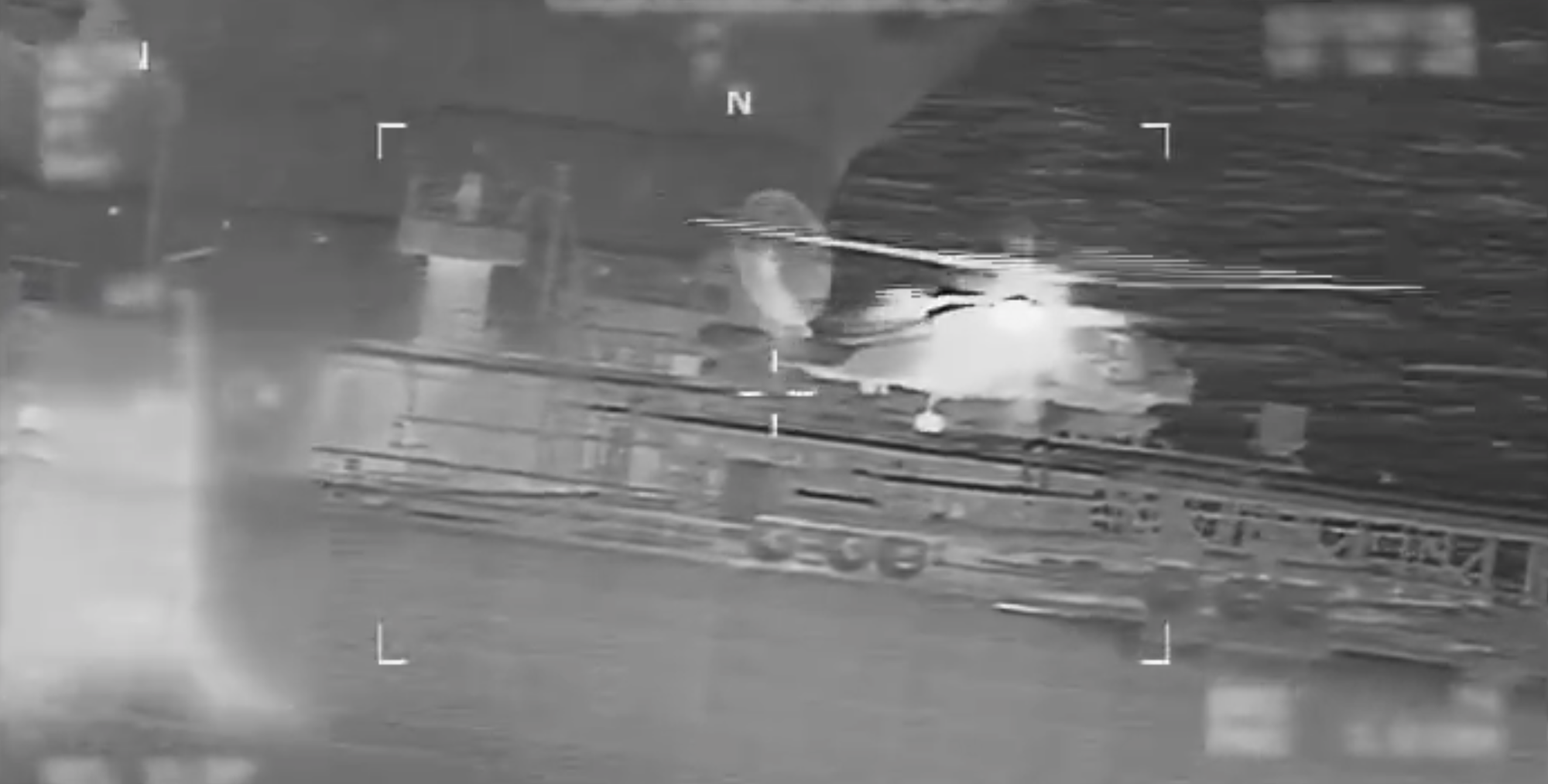
On 20 December, 2025, the United States Coast Guard, with support from the US navy, boarded and seized the Panama-flagged oil tanker Centuries in international waters east of Barbados in the Caribbean Sea. The operation occurred in the pre-dawn hours and involved armed personnel rappelling from helicopters onto the vessel’s deck.
This action was not an anomaly, nor was it a tragic breakdown of an otherwise functional rules based system. It was an explicit demonstration of what that system has always been: a selective enforcement regime that functions when aligned with American power and is discarded the moment it ceases to do so.
US Homeland Security Secretary Kristi Noem announced the action on X with an accompanying video comprising footage taken from the operation.
In a pre-dawn action early this morning on Dec. 20, the US Coast Guard with the support of the Department of War apprehended an oil tanker that was last docked in Venezuela.
— Secretary Kristi Noem (@Sec_Noem) December 20, 2025
The United States will continue to pursue the illicit movement of sanctioned oil that is used to fund… pic.twitter.com/nSZ4mi6axc
The Centuries had loaded approximately 1.8 million barrels of Venezuelan Merey heavy crude oil at a PDVSA terminal, reportedly under the false name “Crag.” Maritime tracking data and internal PDVSA documents indicate the cargo was bound for China. The vessel is part of the so-called “shadow” or “dark” fleet that employs deceptive practices to transport sanctioned oil.
This was the second such seizure in less than two weeks, following the boarding and seizure of the tanker Skipper on the 10th of December. The Skipper had been explicitly sanctioned by the US Treasury and was falsely flying the flag of Guyana. Registration was denied by Guyanese authorities, rendering the vessel effectively stateless and allowing intervention under international maritime law.
The Centuries presents a fundamentally different case. It was not listed on US, EU, or UK sanctions designations. It was properly registered in Panama and reportedly owned by a Chinese firm. Seizing a non-sanctioned, properly flagged vessel in international waters represents a direct violation of the principles governing freedom of navigation and flag state jurisdiction.
The blockade announced by President Trump on 17 December explicitly targeted “all sanctioned oil tankers” entering or leaving Venezuela. The seizure of the Centuries exceeded that scope and did so unilaterally. This was not enforcement within the confines of the rules based order. It was the abandonment of that order when it no longer delivered the desired outcome.
The Blockade and the Limits of Venezuelan Response
President Trump’s blockade order was framed as an effort to enforce existing sanctions on Venezuela’s oil trade, which the United States links to funding “narco-terrorism.” Since the seizure of the Skipper, Venezuelan crude exports have sharply declined. Many loaded tankers remain anchored in Venezuelan waters to avoid the risk posed by the presence of the Gerald R Ford strike group, which entered the USSOUTHCOM Area of Operations in the Caribbean Sea on 11 November , 2025.
Venezuela’s ability to contest the blockade is negligible. Its anti-ship capabilities are mostly limited to coastal defence within 300km, and the Bolivarian Navy consists of a single frigate and several patrol vessels. Direct engagement with US naval assets, or the provision of meaningful naval escorts for outbound shipping, is out of the question.
The Centuries was briefly escorted by Venezuelan naval vessels while transiting territorial waters, but those escorts returned toward Venezuela before the seizure occurred. Neither operational footage nor maritime tracking data show Venezuelan naval assets in the area at the time of boarding.
Shadow fleet vessels such as the Centuries commonly employ false names during loading, AIS manipulation or disabling, flag changes, and planned ship-to-ship transfers, often off Malaysia, to obscure the sanctioned origin of cargo before delivery to refineries primarily in China. Turkey, India, and Egypt are also known recipients of oil transported by shadow fleet vessels.
These practices are deceptive and destabilising. They exploit gaps in enforcement and jurisdiction. They do not, however, constitute piracy, nor do they invalidate flag state protection under international law.
Legal Reality Under UNCLOS
The seizure of the Centuries constitutes a clear violation of the United Nations Convention on the Law of the Sea, or UNCLOS, the foundational legal framework governing maritime conduct.
Under UNCLOS Article 87, freedom of navigation on the high seas is a core principle. Article 92 establishes that vessels on the high seas are subject exclusively to the jurisdiction of their flag state. Exceptions to this rule are narrowly defined in Article 110 and include piracy, slave trading, unauthorised broadcasting, statelessness, or explicit consent from the flag state.
None of these exceptions apply in the case of the Centuries.
The vessel was properly flagged in Panama. It was not stateless. It was not designated as sanctioned. Its deceptive commercial practices do not meet the legal definition of piracy, which requires acts of violence for private ends. Panama did not grant consent for boarding or seizure.
The seizure therefore represents the extraterritorial application of US domestic sanctions law in international waters without multilateral authorisation. This is not a legal grey area. It is a straightforward breach of international maritime law.
By contrast, the seizure of the Skipper was legally defensible precisely because its false flag rendered it stateless. That distinction underscores the significance of the Centuries seizure. The United States knowingly crossed a legal threshold and did so openly.
Ukrainian Strikes and the Decay of Peace
These events occur alongside parallel developments that further expose the hollowness of the rules based order. On 19 December , 2025, Ukraine’s Security Service conducted a drone strike on the Oman-flagged tanker Qendil off the coast of Libya in the Mediterranean Sea. This marked the first Ukrainian attack on a commercial vessel outside the Black Sea region.
The vessel was reportedly part of Russia’s shadow fleet and was empty at the time of the strike. Ukraine justified the attack on the grounds that shadow fleet revenues support Russia’s war effort.
This justification does not withstand legal scrutiny. Under international humanitarian law, civilian merchant vessels are protected unless they constitute military objectives. Economic contribution alone does not meet the threshold of an effective contribution to military action. The strike therefore constitutes a violation of the law of armed conflict.
The location of the strike further compounds the breach. Conducting attacks in neutral waters undermines principles of neutrality and risks escalation with uninvolved states. The absence of formal NATO or UN authorisation places these actions firmly outside any multilateral legal framework.
Ukraine’s actions, like those of the United States, demonstrate that international law is interpreted expansively when convenient and ignored when restrictive.
Shadow Fleets as Symptom, Not Cause
Shadow fleets are not uncaused anomalies. They are structural responses to a sanctions regime that relies on voluntary compliance and selective enforcement. Estimates suggest between 800 and 1,400 aging tankers operate within these networks, often flagged under jurisdictions such as Panama or Liberia.
These vessels facilitate the export of sanctioned oil from Venezuela, Russia, and Iran through ship-to-ship transfers, false documentation, and digital deception. The Centuries followed this model, loading under a false name and likely planning transfers to obscure cargo origin before delivery to Chinese refiners.
These practices pose real risks. Substandard maintenance and inadequate insurance increase the likelihood of environmental disasters. Transparency is eroded, and navigational safety is degraded. The International Maritime Organization has repeatedly condemned such practices and called for stronger flag state accountability.
Yet enforcement remains fragmented because the system itself is fragmented. Economic incentives, particularly China’s demand for discounted crude, ensure that shadow fleets remain not only viable but an essential part of business. The rules based order offers no mechanism to resolve this contradiction without coercion.
The Cruel Fate of International Law
The rules based international order is often presented as a neutral framework of norms and institutions. In reality, it has always functioned as an instrument of American power, enforced when useful and ignored when obstructive.
Sanctions regimes lack universal enforcement. Multilateral institutions lack coercive authority. When compliance falters, enforcement reverts to force.
The US blockade of Venezuela and the seizure of the Centuries illustrate this reality. Diplomatic avenues such as de-flagging requests, port state controls, or multilateral inspections have failed to deliver results. Faced with that failure, the United States chose direct military enforcement.
Ukraine’s strikes against commercial shipping reflect the same logic. In the absence of effective international mechanisms, states act unilaterally and justify those actions retroactively.
This is not the collapse of a rules based order. It is the exposure of its limits.
Power as the Final Authority
The seizure of the Centuries underscores a reality long obscured by diplomatic language. International law constrains only those willing to be constrained. When it ceases to serve power, it is discarded.
The same system that condemns shadow fleets for undermining maritime norms now normalises helicopter boardings and drone strikes in international and neutral waters. This is not hypocrisy born of decay. It is hypocrisy built into the foundation.
The rules based order was never a universal consensus. It was a framework maintained by American dominance and selectively enforced in its interests. As that dominance is contested, enforcement shifts from law to force.
There is only one law of the sea: strength. When rules fail to deliver outcomes, great powers enforce their will directly, accelerating the transition from legal fiction to open coercion.
The question is no longer how to preserve the rules based order. It is what replaces a system that was never impartial, never universal, and no longer even pretends to be.