
The Selective Outrage of Golders Green
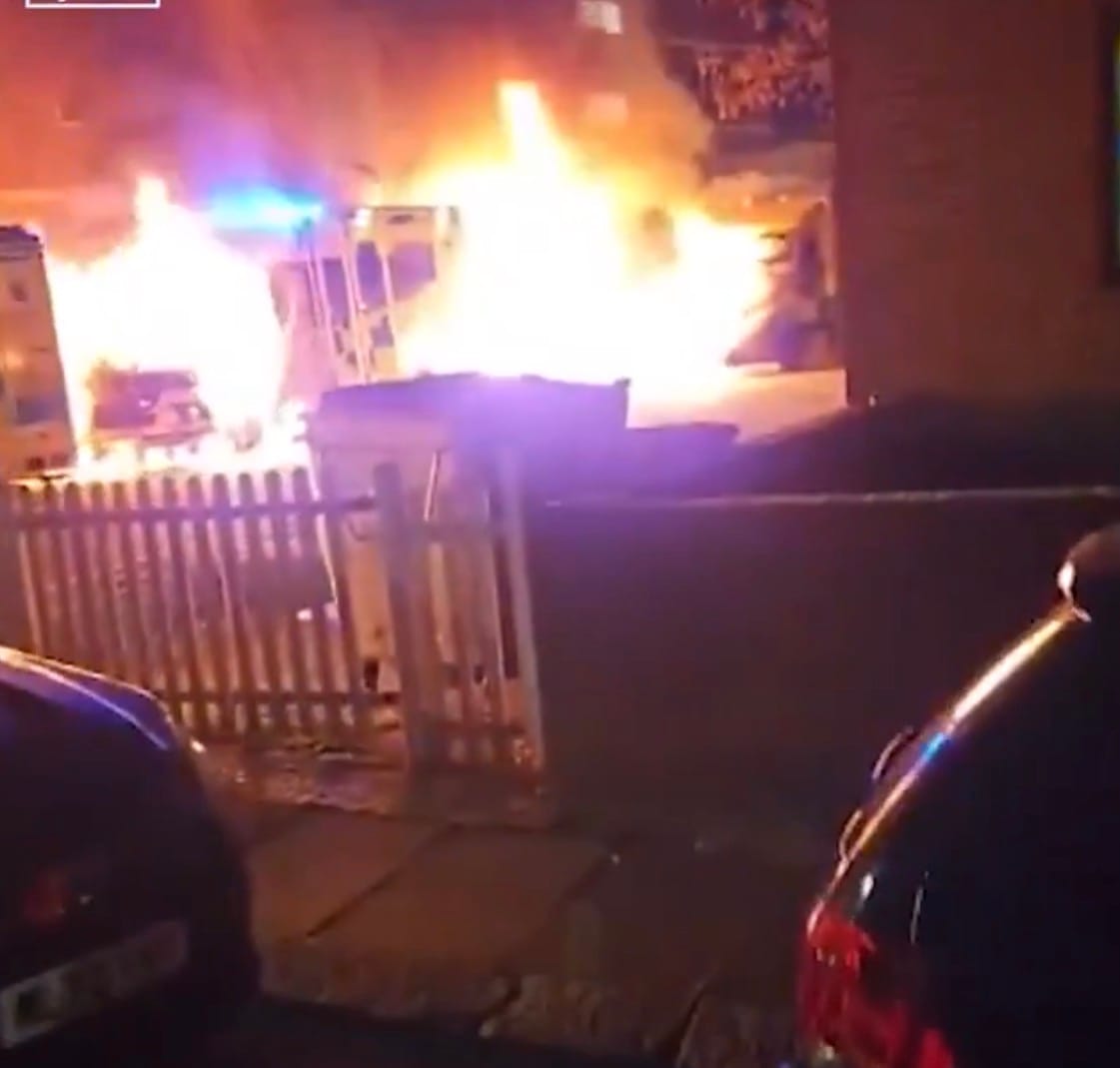
Four Jewish charity Hatzola ambulances were recently set on fire by three hooded individuals on Highfield Road in Golders Green, North London. The incident, which was caught on CCTV, showed the men pouring accelerant onto the vehicles, which were parked next to a synagogue, before fleeing the scene.
It has since been investigated and treated as an antisemitic hate crime by the Metropolitan Police. Two “British nationals” in their 40s were initially arrested in connection with the attack, but both men have since been released on bail. Helen Flanagan, commander of the counter-terrorism force at the Metropolitan Police, has assured the public that their enquiries are ongoing and that they aim to “identify all of those involved in this appalling attack”.
Residents in the nearby area were evacuated while emergency services put out the blaze. As the fire raged, the oxygen cylinders in the vehicles exploded, shattering the windows of a nearby synagogue. No one was injured.
Though it seems obviously targeted at the Jewish community, which makes up half of the residents in the area, the collective hysteria surrounding the attack has already been a revealing symptom of our current times.
The Selective Outrage Barometer
In the days after the incident, extra police patrols were deployed as a precautionary measure to the location. This included numerous armed patrols in the area, which is unusual for a police force famous for the opposite. Commissioner of the Metropolitan Police, Sir Mark Rowley, said, “Our Jewish communities have been increasingly targeted by groups and individuals intent on spreading fear, harm and hate. There is no ‘us and them’. There is only an attack on a British community.”
In addition, there were joint co-operation efforts and patrols with the Shomrim, a Jewish volunteer policing group, and an additional security plan for Jewish schools, synagogues and community centres.
In Golders Green, there was a sizeable “Stop The Hate” protest, a Jewish-led direct action campaign group dedicated to “empowering Jews, tackling antisemitism and advocating for Israel and a free Iran”.
The Health Secretary, Wes Streeting, visited the area, warning that “antisemitism in Britain had reached an alarming level. I have not known a level of fear and anxiety among Britain’s Jews in the way that we see today, people questioning whether Britain is a safe place to be Jewish. That should shock and shame us”.
Streeting added, “We cannot stand for this. That is why every decent person in this country needs to speak up and why we as a Government have got to take action. We are investing in security, we are taking action to discipline and remove racism from the NHS, and we are investing in education in schools. But the answer cannot just be higher walls, thicker doors, more CCTV and more money spent on the problem. This is a hateful ideology. It needs to be beaten in the battle of ideas and we have to build a common front against racism of all types.”
Strong words from the Health Secretary, though you would be remiss in finding a similarly strong statement after the Southport stabbings, even after it was revealed that Southport attacker Axel Rudakubana harboured a deep hatred of white people, and that he had materials relating to “white genocide”. Curiously, there is also no mention at all of Wayne Broadhurst on his social media, who was brutally murdered by an Afghan refugee for simply walking his dog, or asylum hotel worker Rhiannon Whyte, who was killed by a Sudanese asylum seeker with a screwdriver. But we remember, even if Mr Streeting does not.
Keir Starmer labelled the attack “horrifying” and said that “an attack on our Jewish community is an attack on us all. We will fight the poison that is antisemitism.” Senior Jewish figures and community leaders were also granted an audience and a seat at 10 Downing Street following the attack, along with the Health Secretary and the MP for Finchley and Golders Green, Sarah Sackman. Starmer added, “The idea that we live in a society where people should feel they need to hide their identity or their religion is, frankly, abhorrent.”
A curious statement, considering many Britons feel they need not only to suppress their identity, but effectively to muzzle themselves from expressing inconvenient opinions about the state of the country that may upset the governing class. Britain recorded a staggering 12,813 arrests simply for “online comments” in 2023 alone, higher than any other country on earth.
Nigel Farage of Reform UK was quick to condemn the attack, stating that “the horrible attack on volunteer ambulances is part of a rising tide of hate against Jewish communities in Britain.” Again, strong words, yet there were none from Farage on the murder of Wayne Broadhurst or Rhiannon Whyte, and he rarely speaks of the weekly rape of British women and girls at the hands of migrants and foreign sex offenders. He has also yet to follow through on Reform’s own rape gang inquiry that he initially promised months ago.
The man’s priorities are clearly not with the British people. Reform even suspended mayoral candidate Dr Chris Parry for his comments, where he appeared to describe members of the Shomrim, or the Jewish voluntary watch patrol, as “cosplayers” and made comparisons with the “Islamists on horseback”, similar to what was seen in Bradford. Parry, a retired Royal Navy officer who served during the Falklands War, was due to stand in the first Hampshire and Solent mayoral election. Farage called Mr Parry’s comments “hurtful and wrong”.
Parry had posted on X citing what he described as a double standard: “Can Christians in Britain set up their own police and patrol certain neighbourhoods?” alongside a picture of Shomrim vehicles. He added, “Remember that these cosplayers have no more jurisdiction or legal authority than ordinary citizens.” After he faced multiple challenges to his original post, he later responded, “My point still stands. They are a community organisation, not a legal entity. It is the same with Islamists on horseback. But if it offends you, I will remove it.”
It obviously offended his leader, who has a known track record of removing and stepping over people he disagrees with, or those who show even a flicker of independent thought. Rear Admiral Parry made a point regarding both Muslim and Jewish communities having their own forms of community patrols, which he argued highlighted a lack of integration.
Farage has, of course, gone on record defending Jews as a people and the threats they face, yet cannot bring himself to defend, or even acknowledge, wider demographic concerns, as was raised in the Steven Eggington interview. He instead focuses on more familiar cultural arguments, defending certain communities without hesitation, while failing, in the author’s view, to address other issues affecting the wider population.
This also comes shortly after Reform UK accepted a Labour defection in the form of Hartlepool councillor and foreign national Aaron Roy, who moved to the UK from India six years ago. Roy has described himself as Hartlepool’s first “BAME councillor”. However, this is a separate matter.
The rest of the political class were united in their condemnation of this arson attack, standing in solidarity with the Jewish community, as would be expected, and calling for further action.
It Is All So Tiresome
Nothing quite summed up the reaction to this arson attack more than Julia Hartley-Brewer on TalkTV.
“This is how it happens, this is how six million Jews were sent to the gas chambers. I am not exaggerating.”
If you are not speaking out against antisemitism, then you are “part of the problem”, she says. Of course, antisemitism is a broad term, similar to what some describe as “Islamophobia”.
Those who are critical of the IDF, revisionist Zionism as a distinct ideology, or even Israel itself, are at times labelled with that same term, which can have the effect of limiting opposition.
This situation has highlighted what some perceive as selective outrage within parts of the political class and the media, particularly in how different incidents are framed and prioritised.
The Manchester synagogue-related incidents remain fresh in many people’s minds. The wider Israel–Palestine conflict has also influenced tensions within the UK, particularly in diverse communities. Such international conflicts can have domestic repercussions in a multi-ethnic and multi-faith society.
Following the Manchester Arena bombing, the phrase “Don’t Look Back in Anger” became widely associated with the public response. Messages of unity were strongly emphasised by political and media figures.
The framing of different incidents can vary. Some are presented primarily as moments for unity, while others are framed as requiring a more forceful response.
Concerns raised by members of the public in response to serious crimes or social issues are sometimes debated, challenged or dismissed, depending on context and interpretation.
The right to express outrage can appear unevenly distributed, depending on the circumstances and the groups involved.
This has contributed to a broader debate about fairness, consistency and representation in public discourse.